
-
Partager cette page
Corsci Seminar
Publié le 1 décembre 2025
– Mis à jour le 2 décembre 2025
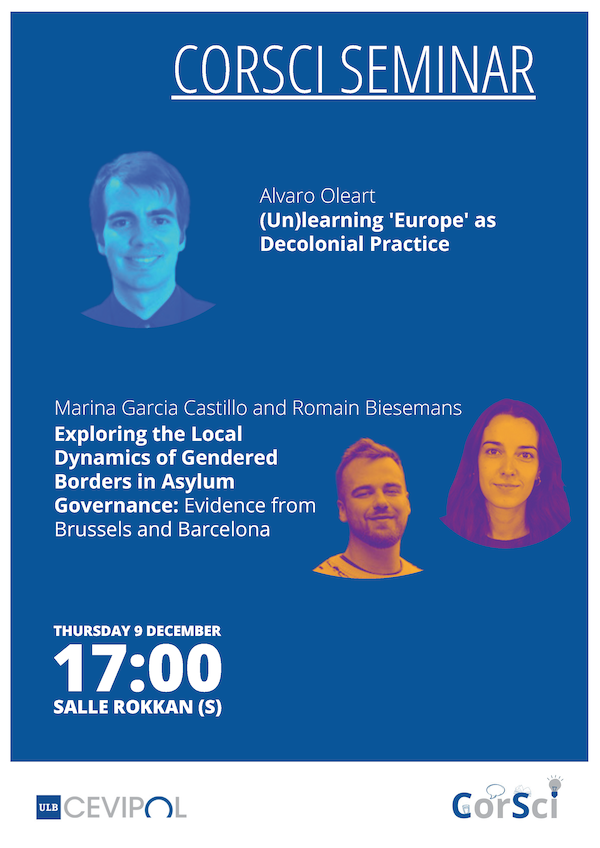
During the seminar, Alvaro Oleart, Marina Garcia Castillo and Romain Biesemans will present 2 communications.
Author: Alvaro Oleart
Title: (Un)learning ‘Europe’ as Decolonial Practice
Abstract: While critical approaches have emerged in recent years, mainstream European Studies scholarship has insufficiently acknowledged the relevance of colonialism, racism and broader imperialist practices to study not only the past, but also the present. This Special Issue puts forward a decolonial approach to European Studies, connecting material and epistemic injustices to emphasize the political relevance of scholarly work and the necessity of self-reflexivity. This not only facilitates a deep introspection of the EU, which needs to reconcile its colonial history with its aspirations for global justice and equality, but also of the field of European Studies, which often aligns its research priorities with the institutional agendas of the EU. Decolonial practice thus not only aims to analyze political reality, but also to provide conceptual tools to make sense of, and to change, this reality. We therefore advocate the logic of decoloniality to challenge Eurocentric narratives that continue to conceive of Europe as the birthplace of modernity, as synonymous with progress and civilization, and as white. This involves engaging seriously with epistemologies from the Global Souths and Global Easts, and addressing the ethical and material imperatives of decolonization. Working on ‘Europe’ without presuming it to be the center of the planet ensures that the stories of those who have been exploited by European colonialism and capitalism are told, heard, and given epistemic weight. These stories, in turn, have the potential to transform how we understand Europe itself.
Author: Marina Garcia Castillo
Title: Exploring the Local Dynamics of Gendered Borders in asylum: Evidence from Brussels and Barcelona
Abstract: This research examines the intersection of gender and migration at the local level of asylum governance, focusing on the politics of gendered borders within civil society organizations (CSOs) and public officers. By gendered borders, we aim to study the interaction between asylum and migration with sexual orientation and gender identity (SOGI). Using a comparative case study of Brussels and Barcelona -two contexts marked by cultural diversity, strong migration flows, and active gender-equality networks- the paper investigates how professionals working in CSOs interpret and navigate gendered, sexual, and national boundaries in asylum-related work. By comparing Brussels and Barcelona, the study highlights how local governance, CSO’s cultures, and intersectional inequalities shape the governance of asylum. It argues that practitioners do not only implement policy but also produce situated forms of epistemic resistance (Siraj 2016; Peumans & Stallaert 2016) and bordering practices that reconfigure notions of belonging and protection. The paper advances empirical and theoretical understandings of how gendered borders are constructed, contested, and lived in local asylum governance.
The presentations will be followed by a convivial moment with drinks and pizzas.
Date(s)
Le 9 décembre 2025
17:00 - 18:30
Lieu(x)
Campus du Solbosch - ULB
Salle Rokkan (S.12.234)
Bâtiment S, 12è étage
44, Avenue Jeanne - 1050 Bruxelles
Contact
Registration required :
Romain.Biesemans@ulb.be