

- Faculté de Philosophie et Sciences sociales
- Accueil
- Agenda FAC
- Agenda SC PO
-
Partager cette page
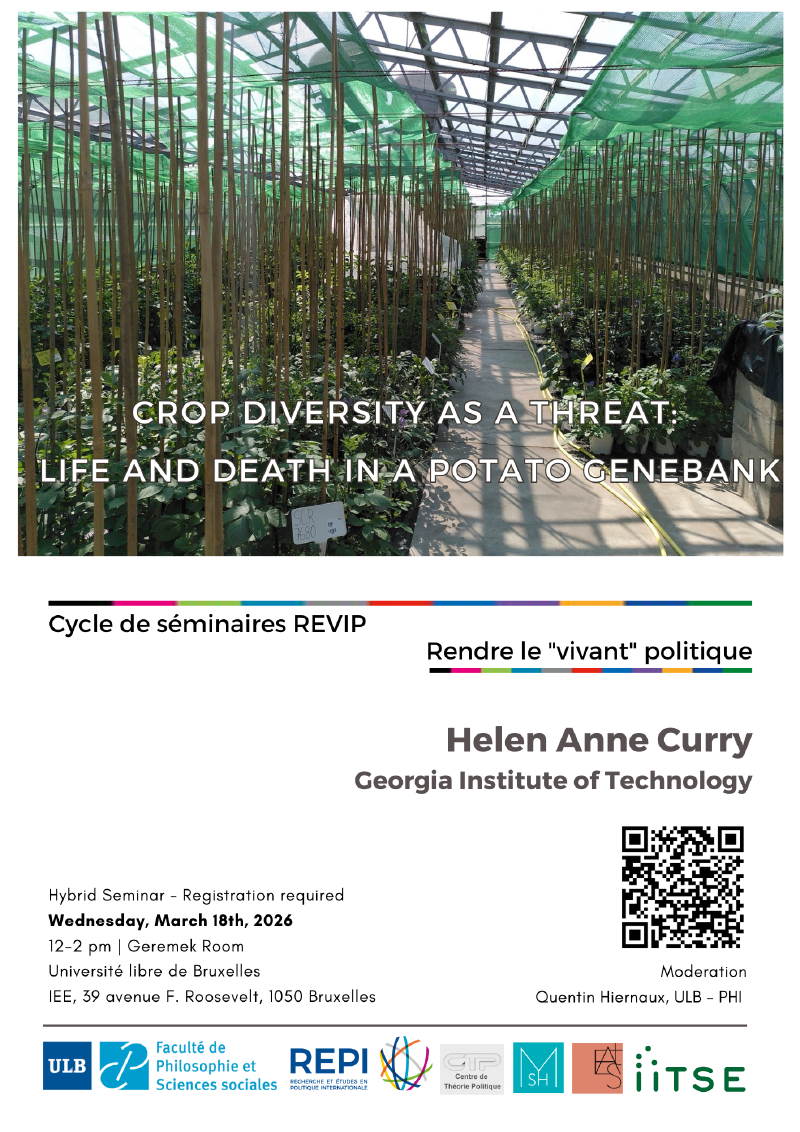
Crop Diversity as a Threat: Life and Death in a Potato Genebank
Publié le 30 janvier 2026
– Mis à jour le 17 août 2026
REVIP Seminar Cycle. Guest speaker : Helen Anne Curry, Georgia Institute of Technology
Abstract
Since the early twentieth century, farmer’s varieties and crop wild relatives have been heralded as important sources of genetic disease- and pest-resistance. They have been secured through bioprospecting expeditions and placed in genebanks where they can be made available to breeders in sites far removed from their original habitats. Yet the transit of seeds and plants across lands and oceans brings risks, and none greater than that of introducing new pests and diseases that will further endanger vulnerable monocultures. This talk explores the history of efforts to manage the risk of disease introduction that arises from the search for new sources of disease resistance through a study of one of the world’s most important potato genebanks, the Commonwealth Potato Collection. It emphasizes the complex relationship between managing monocultures and maintaining crop diversity and reveals that crop diversity has been understood as a source of both security and risk in industrial agriculture.
Dr Helen Anne Curry is Melvin Kranzberg Professor in the History of Technology at the School of History and Sociology, Georgia Institute of Technology. She is an Honorary Senior Research Fellow at the Department of History and Philosophy of Science, University of Cambridge, where she leads the multi-researcher project, “From Collection to Cultivation: Historical Perspectives on Crop Diversity and Food Security” with funding from the Wellcome Trust. Her current research centres on the histories of seeds, crop science, and industrial agriculture. She is author of Evolution Made to Order: Plant Breeding and Technological Innovation in Twentieth Century America (University of Chicago Press, 2016) and Endangered Maize: Industrial Agriculture and the Crisis of Extinction (University of California Press, 2022).
Moderation : Quentin Hiernaux, ULB (PHI)
Wednesday, March 18th, 2026
From 12 to 2 pm
The event will be held in a hybrid format.
Registration required by March 16: https://forms.office.com/e/ef3WnWmBVG?origin=lprLink
REPI
Université libre de Bruxelles
IEE RT39 Geremek Room
Avenue F. Roosevelt 39
1050 Bruxelles
With the support of the Faculty of Philosophy and Social Sciences
2025-2026 Programme
Since the early twentieth century, farmer’s varieties and crop wild relatives have been heralded as important sources of genetic disease- and pest-resistance. They have been secured through bioprospecting expeditions and placed in genebanks where they can be made available to breeders in sites far removed from their original habitats. Yet the transit of seeds and plants across lands and oceans brings risks, and none greater than that of introducing new pests and diseases that will further endanger vulnerable monocultures. This talk explores the history of efforts to manage the risk of disease introduction that arises from the search for new sources of disease resistance through a study of one of the world’s most important potato genebanks, the Commonwealth Potato Collection. It emphasizes the complex relationship between managing monocultures and maintaining crop diversity and reveals that crop diversity has been understood as a source of both security and risk in industrial agriculture.
Dr Helen Anne Curry is Melvin Kranzberg Professor in the History of Technology at the School of History and Sociology, Georgia Institute of Technology. She is an Honorary Senior Research Fellow at the Department of History and Philosophy of Science, University of Cambridge, where she leads the multi-researcher project, “From Collection to Cultivation: Historical Perspectives on Crop Diversity and Food Security” with funding from the Wellcome Trust. Her current research centres on the histories of seeds, crop science, and industrial agriculture. She is author of Evolution Made to Order: Plant Breeding and Technological Innovation in Twentieth Century America (University of Chicago Press, 2016) and Endangered Maize: Industrial Agriculture and the Crisis of Extinction (University of California Press, 2022).
Moderation : Quentin Hiernaux, ULB (PHI)
Wednesday, March 18th, 2026
From 12 to 2 pm
The event will be held in a hybrid format.
Registration required by March 16: https://forms.office.com/e/ef3WnWmBVG?origin=lprLink
REPI
Université libre de Bruxelles
IEE RT39 Geremek Room
Avenue F. Roosevelt 39
1050 Bruxelles
With the support of the Faculty of Philosophy and Social Sciences
2025-2026 Programme
Date(s)
Le 18 mars 2026